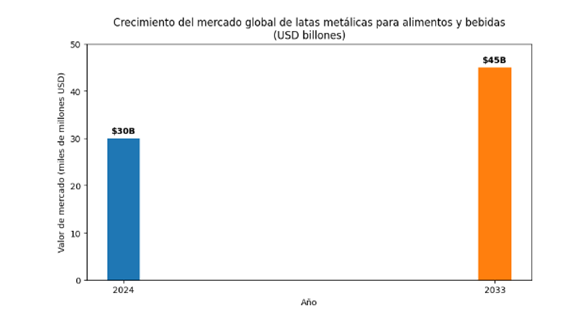
The global food and beverage metal can market will grow at a compound annual rate of 5.5% between 2026 and 2033, according to a report by Verified Market Reports. In 2024, the sector was valued at $30 billion, and it is projected to reach $45 billion by the end of the forecast period.
Sustainability is establishing itself as one of the primary market drivers. Aluminum and steel cans are increasingly preferred for their infinite recyclability and high recycled material content. Brands are leveraging these advantages to meet circular economy and ESG goals, reducing the carbon footprint throughout the life cycle of packaged food and beverages.
Product premiumization and differentiation are also driving growth. Innovations in can shapes, digital printing, and tactile coatings allow for the creation of aesthetically attractive packaging, reinforcing the shelf impact of craft beverages, functional drinks, and gourmet foods.
The rise in ready-to-drink (RTD) applications responds to urbanization and time-constrained consumers. Cans offer a superior barrier, food safety, and extended shelf life without the need for preservatives.
Industrial automation and smart solutions, such as high-speed filling lines and AI-driven quality control, optimize production, reduce costs, and improve overall efficiency.
The market also benefits from favorable regulatory changes, including restrictions on single-use plastics and stricter food safety standards, while regions such as Asia-Pacific lead in volume, and North America and Europe focus on premium and sustainable products.
The combination of environmental regulations, efficient recycling, and cost advantages consolidates metal cans as a preferred packaging option in the medium and long term, offering economic, sustainable, and branding advantages over other materials.
 The European Canned Food Market is Projected to Experience Solid Growth through 2033.
 Food can market to reach $38.4 billion in a decade
 Metal cans market to grow $81.5 Billion by 2032
 Beverage packaging market to exceed $277 billion by 2032
 The metal packaging market will reach 75 billion dollars
 Food and Beverage Metal Cans Market by Region. South America
 Food and Beverage Metal Cans Market by Internal Pressure Grade
Food and Beverage Metal Cans Market by Material
Food and Beverage Metal Cans Market by Application
Food & Beverage Metal Cans Market By Type
Food and Beverage Metal Cans Market by Internal Pressure Grade
Food and Beverage Metal Cans Market by Material
Food and Beverage Metal Cans Market by Application
Food & Beverage Metal Cans Market By Type