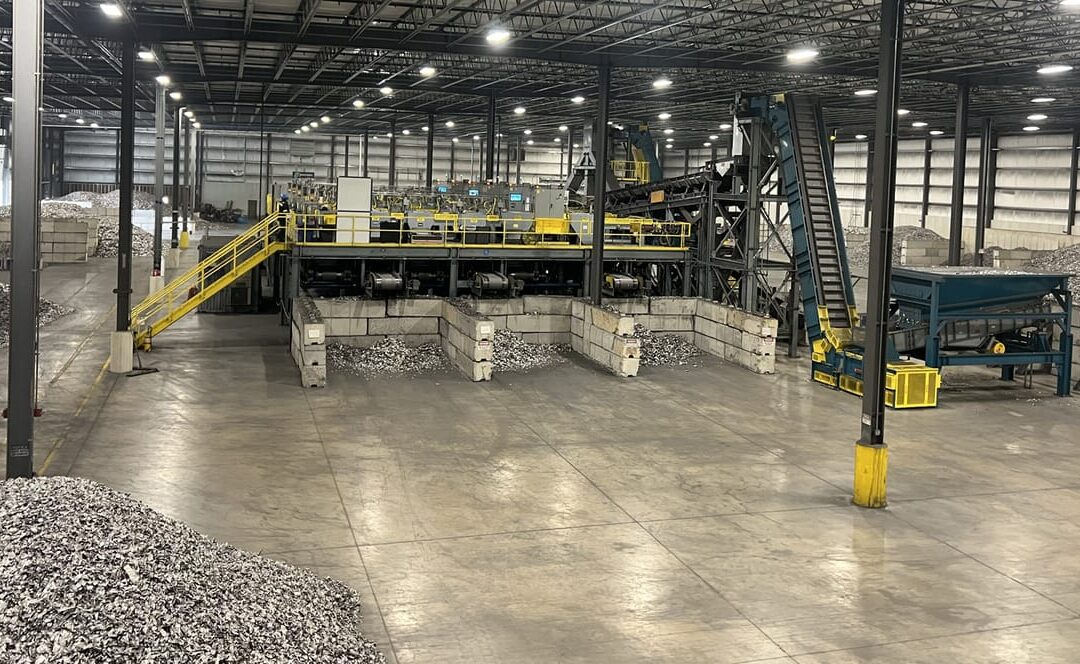
Sortera, based in Indiana, has developed a system that allows for highly accurate classification of mixed aluminum alloys, keeping high-value metal within the country and reducing the need to export it.
The plant in Markle, Indiana, classifies 8 to 16 different alloys per pass, with a capacity of 5 to 8 tons per hour. A second facility near Nashville, Tennessee, will open in 2026, projecting a combined production of 240 million pounds of aluminum per year. The main customers come from the automotive, aerospace, construction, and packaging sectors, all focused on lighter and more efficient products.
In 2024, annual aluminum consumption in the U.S. reached nearly 12 million tons, remaining approximately 4 million below demand, which continues to increase, driven by new rolling mills and plants that open each year. Despite the abundance of aluminum scrap, much of it is not efficiently reused and ends up in low-value applications or exported to Asia for manual sorting.
Sortera Technologies, founded in 2020, buys mixed aluminum from shredders, classifies it by specific alloys using artificial intelligence and advanced sensors, and then sells it for high-value applications. The process achieves a purity of at least 98 %, which allows direct feeding into furnaces and production of components from engine blocks to construction elements, without costly secondary steps.
Recycled aluminum also offers economic and environmental advantages: it is cheaper than primary aluminum, reduces energy consumption by up to 95 %, and significantly decreases emissions.
Sortera’s system overcomes the limitations of traditional technologies by distinguishing specific alloys, including cast and rolled aluminum, which previously could only be achieved through export or material degradation.
The company has raised more than $100 million with the support of aluminum consumers such as Novelis and Mitsubishi, venture capital, and major investors such as Macquarie and T. Rowe Price. According to CEO Michael Siemer, the company started as a small experimental project and has already produced 100 million pounds of alloys in its first full year of operation.
“While we are starting with aluminum, our goal is to cover other metals in the future, ensuring that as much as possible remains in the U.S. and is used in high-value applications,” says Siemer.
Sortera Technologies demonstrates that technological innovation and artificial intelligence can transform metal recycling, strengthening the circular economy and the domestic supply of strategic aluminum.
 EGA Spectro Alloys Inaugurates Aluminum Recycling Plant in Minnesota
 TOMRA Presents Advanced Deep Learning Solution to Optimize Forged Aluminum Recycling
 GME creates the first automatic recycling plant in Africa
 Tri-Arrows and Tennessee Aluminum to build recycling plant in Kentucky
 EGA intends to acquire a majority stake in Spectro Alloys Corporation
 Uneven growth of German aluminum
 EGA, a leading global aluminum company, has confirmed the acquisition of Leichtmetall, a German company focused on aluminum recycling.
 TOMRA revolutionizes the market with its AUTOSORT PULSE