
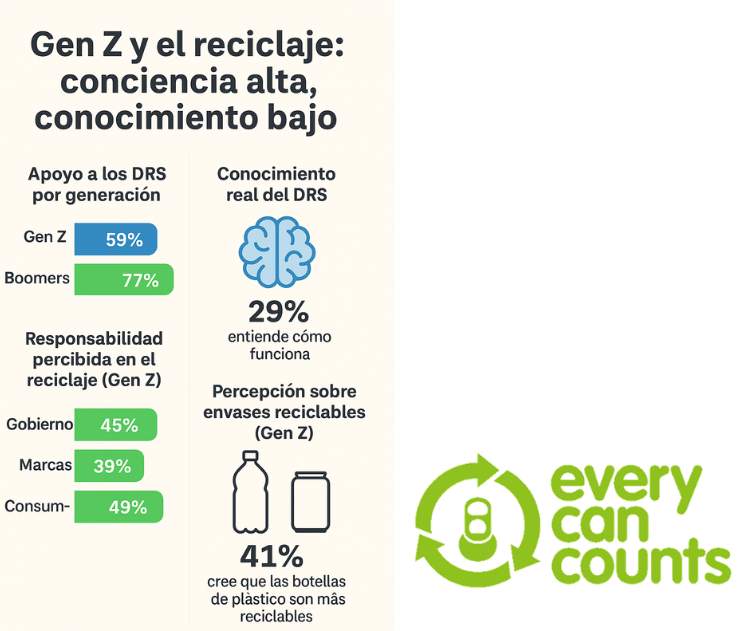
Although young people are leading climate mobilizations and denouncing corporate greenwashing, only 59% of Generation Z (16-28 years old) support deposit return schemes (DRS), compared to 77% of Baby Boomers (55-74 years old), according to a recent study in the United Kingdom commissioned by the non-profit organization Every Can Counts (ECC).
The report reveals a surprising generational gap amid a wave of youth climate activism. While young people show concern for sustainability, they seem less convinced that current recycling systems generate a tangible impact.
Acceptance of DRS increases with age: 59% of Gen Z, 66% of Millennials, 75% of Generation X, and 77% of Boomers. However, only 29% of Gen Z state that they know how the system actually works, which points to a lack of information and commitment rather than disinterest.
The United Kingdom plans to implement its own DRS in 2027, a program in which consumers will pay a small refundable deposit for beverage containers and recover it when they return them for recycling. Although seven out of ten Britons support the measure, less than half claim to fully understand how it works, especially among young people.
The study also indicates that participation could increase if recycling were more interactive or if citizens better understood its environmental impacts: 64% stated that they would recycle more if it were fun, and 80% if they better understood its ecological effects.
Despite their pro-sustainability language, Gen Z has doubts about key concepts: only 44% correctly associate “circular packaging” with the possibility of being continuously recycled into the same type of product, and only 50% understand that “recyclable packaging” implies design for circularity, compared to 56% of Boomers.
The pressure on brands is high among young people: 74% believe that they should use fully recyclable or recycled materials, although only 39% consider brands responsible for recycling cans, compared to 44% of Millennials and 47% of Generation X. In contrast, young people assign more responsibility to the government (45%), almost double that of Boomers (26%).
Chris Latham-Warde, program manager at Every Can Counts, stated: “Generation Z cares about the planet, but not knowing how DRS works could affect their recycling habits.”
The study also dispels common perceptions about packaging: although aluminum cans are the most recycled beverage containers in the world, only 20% of respondents recognize this, and 41% of Gen Z believe that plastic bottles are recycled more. ECC sees this as an opportunity to educate about the circular credentials of the can.
 According to a global study by Every Can Counts, 71% of citizens support deposit and return systems.
 Touching the Heart of Generation Z: These are the Keys to the Favorite Metal Packaging of Young People
 Every Can Counts, the most Sustainable Presence at the Download Festival
 Young People Recycle less than Older Ones According to Can Makers UK
 Every Can Counts celebrates World Recycling Day with break dancing
 Every Can Counts turns 15
 Every Can Counts initiative arrives in the United Arab Emirates
 Every Can Counts Announces National Recycling Award Winners
 CONSUMERS INCREASINGLY AWARE OF SUSTAINABLE PACKAGING PURCHASING ACCORDING TO TRIVIUM
 Consumers more aware of their environmental footprint