Hydro has presented its results and strategic plans at its Investor Day 2025, highlighting its progress towards the transition to green aluminum and its ability to generate value despite market uncertainty. The company will close five Extrusion plants in Europe to optimize operations, with a restructuring cost of NOK 1.9 billion (Norwegian kroner), approximately $186.8 million, and annual savings of NOK 500 million ($49.15 million) from 2027.
In parallel, Hydro has launched a staff adjustment and cost reduction program that anticipates saving NOK 1 billion annually from 2026. Its improvement plan, initiated in 2024, is ongoing, with NOK 1.2 billion planned this year and a target of NOK 6.5 billion by 2030.
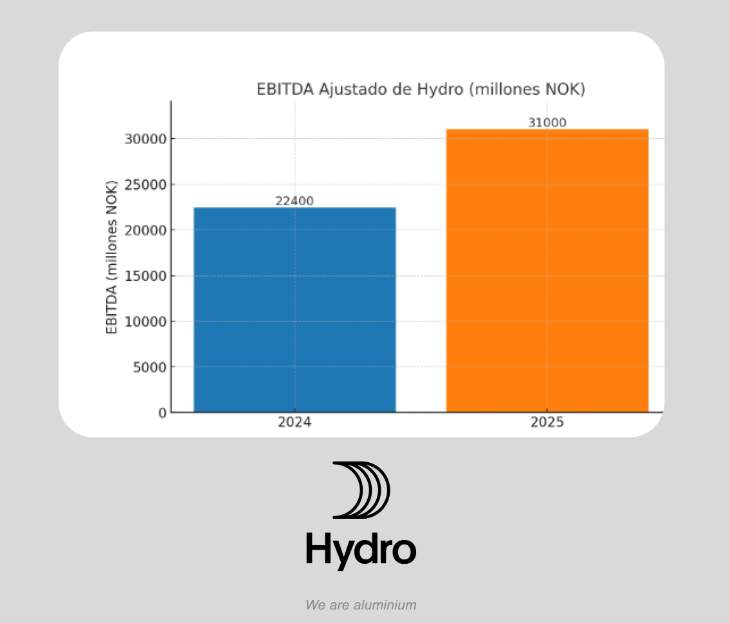
Hydro’s adjusted EBITDA between the fourth quarter of 2024 and the third quarter of 2025 reached NOK 31 billion, compared to 22.4 billion in 2024, reflecting a solid recovery in a context of volatile markets. The company maintains its capital discipline, with CAPEX projected at NOK 13.5 billion for 2025-2026.
Hydro continues to advance in renewable energy and decarbonization. The new
In terms of sustainability and social responsibility, Hydro supported more than 300 community projects in 2025 and has already reached 250,000 people through educational programs, on its way to its goal of 500,000 by 2030.
In addition, the company is boosting its green revenues, with low-carbon and recycled products increasing by more than 50% so far this year, including a Hydro REDUXA sales agreement with NKT for up to 274,000 tons, estimated at 1 billion euros.
The CEO, Eivind Kallevik, emphasizes: “Aluminum will continue to be key in the green transition. Our geographic position and integrated value chain allow us to face volatility and lead the way towards net-zero aluminum with renewable energy.”
 Hydro Signs Long-Term Contract with Power Company Hafslund to Manufacture Green Aluminum
 Diageo Reports Slight Organic Growth, but Operating Profit Falls Due to Extraordinary Costs
 Canpack Reports Solid Financial Results and Announces New Investment in Colombia
 An agreement between Hydro and NKT will allow the supply of aluminum to manufacture a volume of electrical cable that could reach the moon
 Hydro invests NOK 1.65 billion to supply low-carbon aluminum for Europe’s electricity infrastructure
 Hydro obtains tax credits for Kentucky recycling plant and successfully issues €500 million in green bonds for Europe
 Toyo Seikan records significant sales growth in its latest fiscal year
 Hydro produces first batch of recycled aluminum with green hydrogen
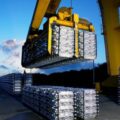 HYDRO POSITIONS ITSELF IN THE THIRD QUARTER DESPITE DIFFICULT MARKET SITUATION
 UNILEVER ANNOUNCES 7% SALES GROWTH DESPITE CHALLENGING ENVIRONMENT